Car Battery Test in Albuquerque: Why Summer Damage Shows Up Now
October 26, 2026Daylight saving time ends Sunday, November 1, 2026, and by mid-November the sun will be setting close to 5:00 PM in Albuquerque. That means a lot of drives home on Paseo del Norte, Montaño and I-40 suddenly happen in the dark. It is a good moment to make sure your vehicle can see the road clearly, and that the cameras your safety systems rely on can see it too.
- Hazy lenses, aging bulbs and poor aim can quietly cut how far your headlights reach.
- Low sun and darkness challenge both your eyes and the cameras behind your windshield.
- A few simple checks keep your lights and your driver assistance systems working together.
Why the Time Change Catches Drivers Off Guard
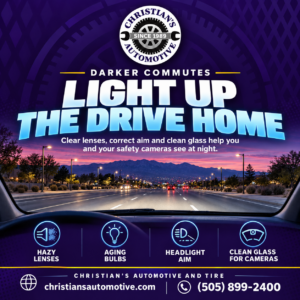 For most of the year, the evening commute happens in daylight, so headlight problems stay hidden. You may not notice that one low beam is dimmer than the other, or that your lenses have turned cloudy, until you are driving home in full darkness. The shift also brings more glare: in the weeks around the time change, a westbound drive on Montaño or Paseo del Norte can put the setting sun right in your eyes. On the way into work, the rising sun over the Sandias does the same thing for anyone headed east.
Your eyes need time to adjust to these new conditions, and so does your routine. The first dark commutes of the season are a good time to slow down a little, leave more following distance and give pedestrians extra attention. Near schools and along busy corridors like 2nd Street, people walking home are harder to spot at dusk than they were a month earlier.
Three Things That Weaken Your Headlights
Headlights rarely fail all at once. They fade, and the change is gradual enough that most drivers adapt without realizing it. These are the most common reasons:
- Cloudy or yellowed lenses. Most modern headlight lenses are plastic, and years of intense high desert sun break down their outer coating. The haze scatters light instead of sending it down the road.
- Aging bulbs. Halogen bulbs dim over their lifespan, and a bulb that still works may be putting out noticeably less light than a new one.
- Poor aim. A headlight aimed too low shortens your view, while one aimed too high blinds oncoming drivers. Suspension work, a minor bump or a heavy load can all shift the aim.
Think of it like a flashlight with a smudged lens and tired batteries. It still turns on, but you have to hold it closer to see what you are looking at. Our repair team can check bulb output, lens condition and aim, and replace bulbs in pairs so both sides match.
One more thing worth checking: many vehicles have daytime running lights that make the dash glow even when the headlights are off. On some models, those running lights do not turn on the taillights, so the back of your vehicle can be dark while the front looks lit. Make sure your switch is set to automatic or on, so your taillights are lit after dark as well. It takes a few seconds and is easy to overlook when the car feels bright from the driver’s seat.
Your Safety Cameras Have to See the Road Too
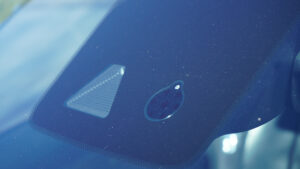 If your vehicle has lane keeping assist, automatic emergency braking or automatic high beams, it likely uses a forward camera mounted behind the windshield near the mirror. That camera is a lot like your own eyes. It struggles with direct glare from a low sun, it sees less in darkness and it cannot look through a dirty or pitted windshield. Many owner’s manuals note that these systems may have reduced performance in low light, bright glare or poor weather, and that is normal behavior rather than a defect.
What you can control is the view. Keep the windshield clean inside and out, especially the area in front of the camera, and replace streaky wipers before the first winter storm. If your windshield has been replaced, or if the camera has been moved, it needs to be calibrated so it knows exactly where it is pointed. We explain why in our post on the safety technology hiding in plain sight. Our in-house ADAS calibration center uses Autel equipment to restore that aim. You can read more about how these systems work on the NHTSA driver assistance technologies page.
Frequently Asked Questions
How do I know if my headlights are aimed correctly?
Park on level ground facing a wall at night and look at where the beams land. If one is noticeably higher or lower than the other, or oncoming drivers flash their lights at you often, have the aim checked.
Do automatic high beams work in every situation?
No. They depend on the forward camera, which can be fooled by glare, reflective signs or a dirty windshield. You can always switch to manual control when the system is not behaving as you expect.
Should I replace both headlight bulbs at once?
It is a good idea. Bulbs age at similar rates, and replacing them together keeps the light output even on both sides.
The earlier sunsets are here for the season, but a clear view of the road does not have to go with them. A quick check of your lights and windshield now makes every dark commute a little easier.
As an AAA Approved Auto Repair shop and a NAPA AutoCare Center, Christian’s stands behind every service with a 5-Year Warranty. Schedule a headlight and visibility check before the darker commutes settle in.
Christian’s Automotive and Tire
8811 2nd Street NW
Albuquerque, NM 87114
(505) 899-2400