
Forward Collision Warning Light On? Here’s What Your Car Is Trying to Tell You
October 2, 2026The balloons are packed away, the mornings on 2nd Street have a real chill in them, and the tires that carried you through a hot summer are about to meet a very different season. Fall is the best time to take an honest look at your tires, before the first cold snap and before the holiday miles start stacking up. It also happens to be a good time to shop, because Goodyear is running rebates on select tires through November 30, 2026.
- Cooler fall air lowers tire pressure, so check it more often as the season turns.
- Tread depth and even wear tell you whether your tires can still grip on wet or icy pavement.
- Goodyear rebates on select tires run through November 30, 2026; ask us which sets qualify.
Why Your Tires Feel Different When the Weather Turns
 Think of the air inside your tires like the air in a basketball left in the garage overnight. When the temperature drops, the air inside contracts and the ball feels a little soft the next morning. Your tires work the same way, and a common rule of thumb is that pressure drops roughly 1 PSI for every 10 degrees of temperature change. In the Rio Grande valley, where a fall afternoon can be 40 degrees warmer than the pre-dawn low, that swing adds up fast. It is often the reason a tire pressure light pops on during a cold morning commute and then goes off by lunchtime.
Underinflated tires flex more, build more heat, wear faster on the outer edges, and take longer to stop. They also make your steering feel vague on a curve like the ramps where I-25 meets Paseo del Norte. The fix is simple: check pressure once a month with the tires cold, before you have driven more than a mile or two. Use the number on the sticker inside the driver’s door jamb, not the maximum pressure molded into the sidewall.
Reading Your Tread: The Penny, the Quarter and the Wear Pattern
Tread is what moves water, slush and grit out from under the tire so the rubber can stay in contact with the road. The classic penny test still works: place a penny upside down in the tread groove, and if you can see the top of Lincoln’s head, your tread is at or near 2/32 of an inch, which is worn out. A quarter works the same way with Washington’s head and shows you roughly 4/32 of an inch. Many technicians, including ours, like to see more than that heading into winter, because traction on wet or icy roads falls off well before a tire reaches the legal limit.
Just as important is how the tread is wearing. Your tires are a record of how your vehicle has been driving, and uneven wear is the story they tell:
- Wear on both outer edges usually points to low pressure.
- Wear down the center often means overinflation.
- Wear on one edge only suggests an alignment problem.
- Scalloped or cupped spots can point to worn shocks, struts or other suspension parts.
If you see any of these patterns, replacing the tires alone will not solve the problem. The new set will simply start wearing the same way. Our tire service includes a look at those patterns so the cause gets addressed along with the tires.
New Tires, Alignment and Your Driver Assistance Systems
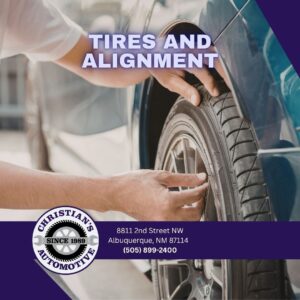 When you put on a new set, an alignment check protects the investment. Potholes on Coors and the rough patches along the West Mesa can knock the wheels slightly out of spec, and fresh tread shows that wear quickly. We walked through how rotation and alignment work together in our post on the math behind rotation and alignment. The short version is that both are cheaper than replacing tires early.
There is also a newer reason to care. On many late model vehicles, lane keeping assist and lane centering rely on the steering angle sensor and a forward camera to know which way the car is pointed. If an alignment changes the thrust angle or the steering wheel position, those systems may need to be checked or recalibrated so they read the road correctly. Christian’s has an in-house ADAS calibration center, so we can handle both in one visit when your vehicle calls for it.
The Goodyear Rebate Window
As a Goodyear dealer, we can help you take advantage of Goodyear’s rebates on select tires, which run through November 30, 2026. Not every tire line or size is included, so the easiest step is to ask us which sets qualify for your vehicle. You can also review current offers directly on Goodyear’s website. We will help you compare options based on how and where you drive, whether that is daily trips on I-40 or weekend drives up to the Sandias.
Frequently Asked Questions
Should I switch to winter tires in Albuquerque?
For most drivers who stay in the metro area, a quality all-season tire with good tread depth is enough. If you regularly drive to the ski areas or into the mountains, a tire with the three peak mountain snowflake symbol is worth discussing with us.
How do I know which Goodyear tires qualify for the rebate?
Goodyear’s rebates apply to select tires purchased through November 30, 2026. Call or stop by and we will tell you which sets for your vehicle qualify.
Why does my tire pressure light come on only in the morning?
Cold overnight temperatures lower tire pressure, and driving warms the tires back up. If the light comes on regularly, your tires are running low and should be adjusted to the door placard pressure.
A few minutes checking pressure and tread now can save you from a slow leak or a slide on a cold morning later this season. If your tires are close to the limit, this fall is a smart time to replace them.
As an AAA Approved Auto Repair shop and a NAPA AutoCare Center, Christian’s stands behind every service with a 5-Year Warranty. Schedule your fall tire check and ask us which Goodyear sets qualify for the rebate.
Christian’s Automotive and Tire
8811 2nd Street NW
Albuquerque, NM 87114
(505) 899-2400