
Heater Blowing Cold? Car Heater Repair in Albuquerque at 5,000 Feet
November 9, 2026Every November, many Albuquerque drivers point their cars east through Tijeras Canyon or north over La Bajada Hill to reach family for the holidays. Those drives are beautiful, and they also ask more of your brakes than a week of stop and go on Paseo del Norte. A brake inspection in Albuquerque before you leave is one of the simplest ways to arrive relaxed instead of wondering about that noise you heard last month.
- Long mountain descents turn braking energy into heat, and heat is what wears brakes and weakens their grip.
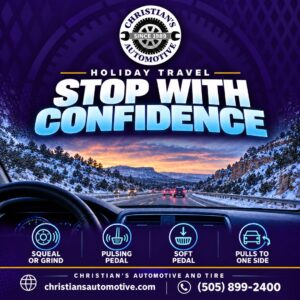
- Squealing, grinding, a pulsing pedal, a soft pedal or a pull to one side are all signs to have your brakes checked.
- Lower gears on long grades, healthy pads and fresh fluid keep your brakes, and your automatic emergency braking, ready to work.
Why Mountain Grades Are Hard on Brakes
 Your brakes do not really stop the car; they turn its motion into heat. Rub your palms together quickly and you feel the same idea: friction makes heat, and the harder and longer you rub, the hotter it gets. On a flat stretch of 2nd Street, your brakes get short bursts of work with plenty of time to cool between lights. Coming down La Bajada southbound or dropping west out of Tijeras Canyon toward the city, gravity keeps pushing the car downhill, so riding the brakes feeds them heat with no break. That is how a perfectly good set of brakes can start to feel weaker near the bottom of a long grade.
Technicians call that weakening brake fade, and it happens in two main ways. Pads and rotors can get so hot that the friction material grips less, so you have to push harder for the same stop. Brake fluid can also get hot enough to boil if it has absorbed moisture over the years, and the vapor bubbles compress, leaving a soft pedal. Brake fluid slowly pulls moisture from the air even in our dry climate, and old fluid boils at a lower temperature than fresh fluid. That is why fluid condition belongs in every thorough inspection.
Signs Your Brakes Need Attention
Your brakes usually tell you when they need help, if you know what to listen and feel for. Many pads have a small metal wear indicator that squeals against the rotor when the pad gets thin, which is a built in reminder rather than an emergency. Pay attention to these signs on your daily drive along Montaño or Coors:
- A high pitched squeal when braking that does not fade after the first few stops of the day
- Grinding or growling, which can mean the pad material is gone and metal is touching metal
- A pulsing pedal or shaking steering wheel when you slow from highway speed
- A pedal that feels soft, sinks lower than usual or needs pumping
- The car pulling to one side when you brake
- A brake warning light or ABS light on the dash
A pulsing pedal usually points to uneven rotor thickness, and it often shows up most when slowing from I-25 speeds. A pull can come from a sticking caliper or uneven pad wear, though worn tires or alignment can play a part too, so a good inspection looks at the whole picture. A soft pedal or a warning light deserves attention before a trip, not after it. None of these signs means you are in danger today, but each one is worth checking while you still have time to plan around it.
How to Descend Tijeras Canyon and La Bajada Like a Pro
 The best habit for a long downhill is to let the engine help. Shift to a lower gear, or use the low or manual mode on an automatic, before the descent starts, and the engine will hold back your speed so the brakes do not do all the work. When you need the brakes, apply them firmly to scrub off speed and then release, rather than resting your foot lightly on the pedal the whole way down. Firm, spaced applications give the pads and rotors time to shed heat between uses. Hybrids and electric vehicles get extra help from regenerative braking, which recovers some of that energy, although the friction brakes still handle harder stops.
There is also a technology reason to keep brakes healthy. Automatic emergency braking can react faster than a person can, but it still stops the car with the same pads, rotors and fluid your foot uses. A forward collision system can only stop the car as well as the hardware underneath allows, so worn pads or tired fluid quietly shrink the margin that safety feature was designed around. We explain more about these systems in our post on the safety technology hiding in plain sight.
What a Pre-Trip Brake Inspection Covers
A thorough brake inspection goes well beyond a quick look through the wheel spokes. We measure pad thickness, check rotors for wear, scoring and runout, look at calipers and slide pins for sticking, and inspect hoses and lines for cracks or leaks. We also test the condition of the brake fluid, since moisture content cannot be judged by looking at the reservoir. With the wheels off, it is a natural time to check tread depth and tire pressure too, because the tires are what actually grip the road when the brakes do their job. Before any long drive, it is also smart to enter your VIN in the NHTSA recall lookup to confirm there are no open recalls on your vehicle.
Frequently Asked Questions
How often should I get a brake inspection in Albuquerque?
A good rule of thumb is to have your brakes checked at least once a year and any time you notice a new noise, vibration or change in pedal feel. Stop and go commuting and frequent mountain trips wear brakes faster, so your driving pattern matters more than the calendar.
Is it safe to drive with squealing brakes?
A squeal is often the wear indicator doing its job, which means the pads are getting thin but still working. Treat it as a reminder to schedule service soon, not a reason to panic. Grinding is different, and it is worth checking before a highway trip because metal on metal can quickly damage rotors.
Holiday travel should be about the people at the end of the road, not the sound coming from your front wheels. A quick brake check before Thanksgiving lets you enjoy the view on the way down Tijeras Canyon.
As an AAA Approved Auto Repair shop and a NAPA AutoCare Center, Christian’s stands behind every service with a 5-Year Warranty. Schedule your pre-trip brake inspection online and head out knowing your brakes are ready.
Christian’s Automotive and Tire
8811 2nd Street NW
Albuquerque, NM 87114
(505) 899-2400